Your body has just completed its most significant physical event. Whether your delivery followed a carefully planned path or took an unexpected turn, the weeks after birth are not about fixing a machine. They are the start of a deliberate, structured rebuild of your physical foundations. The core muscles stretched, the pelvic floor carried extra load, and the connective tissue needs time to settle. A calm, progressive plan can help you reconnect with your body without pressure or comparison.
Many new mothers feel eager to regain core strength, and that is a worthy goal. Yet the early postnatal period rewards patience more than intensity. Gentle movements that support daily tasks matter more than dramatic workouts. The six-week plan outlined here draws on established postnatal exercise principles. It focuses on breath, stability and slow progression. Always check with your doctor or women’s health physiotherapist before beginning any exercise after birth, especially after a caesarean or complicated delivery.
Why the First Six Weeks Set the Tone
During pregnancy, the abdominal muscles naturally stretch apart. This is a normal process influenced by hormones and the growing uterus. The pelvic floor also works under increased load for months. After birth, the uterus gradually returns to its pre-pregnancy size over about six to eight weeks. A caesarean incision typically needs a similar window to heal. This does not mean you should stay in bed the entire time. It means the type of movement matters more than the quantity.
Updated guidance from the American College of Obstetrics and Gynecology notes that after a healthy pregnancy and normal vaginal delivery, gentle exercise can often begin within a few days. That is not a green light for bootcamp classes or heavy weights. It is an invitation to move in ways that support healing. The first five days after birth deserve special care. Rest as horizontal as possible when you can, accept help with meals, and keep activities low and slow. This early rest protects your pelvic floor and allows internal healing to begin without extra strain.
Postnatal core work should strengthen all abdominal muscles, not only the deep layer. It should respect pelvic floor load, restore stability and alignment, and encourage good breathing patterns. Full sit-ups and traditional planks can raise intra-abdominal pressure too early. If your form is compromised, these moves may strain the pelvic floor rather than help it. A better starting point is a short daily practice that reconnects breath with movement.
Breath as the First Core Exercise
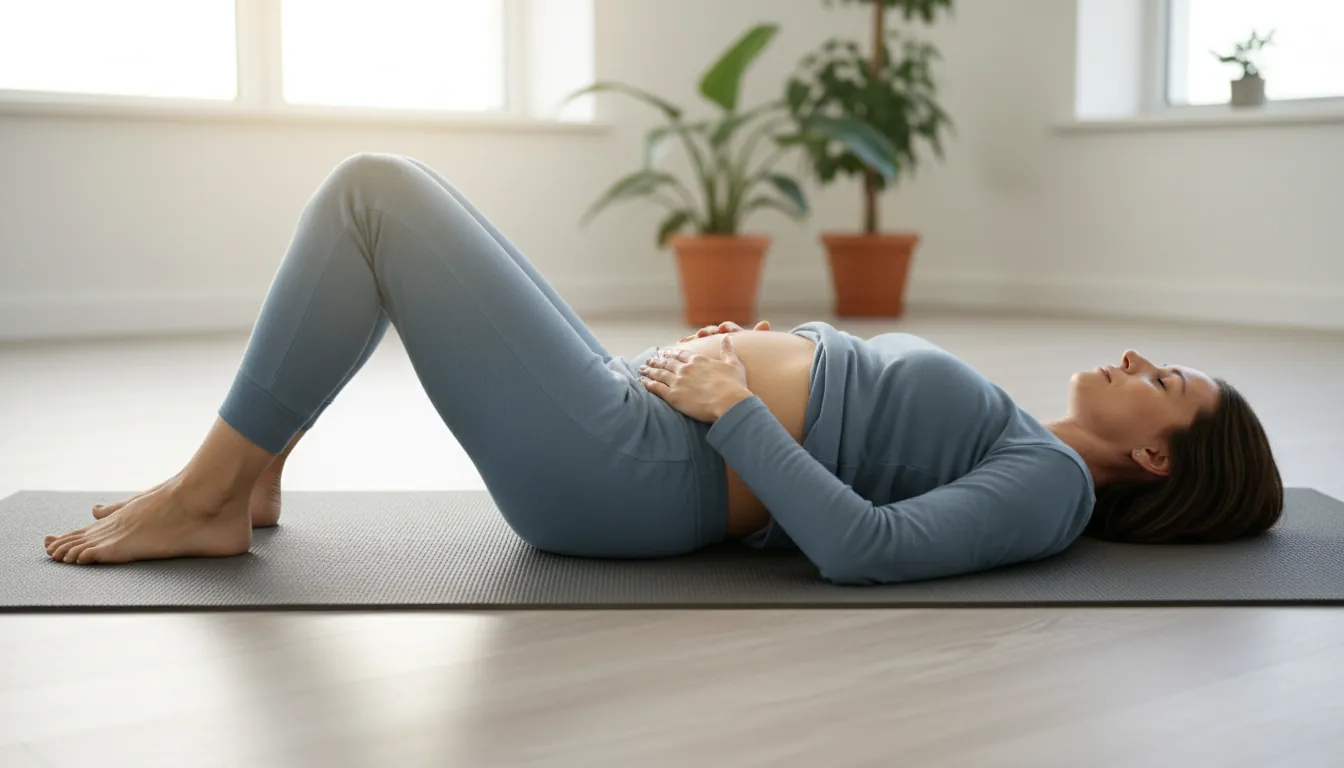
Diaphragmatic breathing is often the most overlooked tool in postnatal recovery. It reconnects the core and pelvic floor while improving deep muscle activation. Lie on your back with knees bent or sit upright in a comfortable position. Place one hand on your ribcage and the other on your lower belly. Inhale slowly through your nose, allowing the ribcage to expand and the belly to rise gently. Exhale through your mouth, feeling the belly lower and the pelvic floor engage softly.
Repeat this for five to ten breaths whenever you have a quiet moment. The benefits extend beyond muscle function. Mindful breathing helps regulate stress hormones during a period of sleep deprivation and emotional transition. It can be done while feeding, lying down, or sitting on the floor with your baby nearby. This simple practice lays the groundwork for every other movement in the weeks ahead.
Pelvic Tilts for Gentle Activation
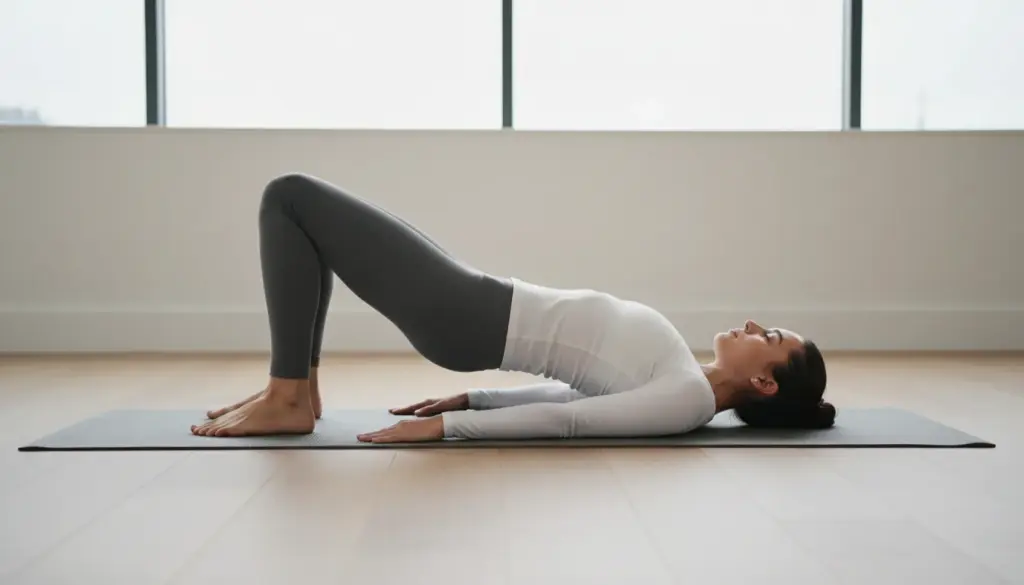
Pelvic tilts activate the deep core and improve pelvic mobility without placing pressure on healing tissues. Lie on your back with knees bent and feet flat on the floor. Inhale to prepare, then exhale as you gently tilt the pelvis backward, pressing the lower back toward the floor. Hold for a moment, then release. The movement should feel small and controlled, not forced. This exercise helps you find the connection between breath and deep abdominal engagement.
Try five to eight repetitions, moving slowly and stopping if you feel any pain or pulling. Pelvic tilts can be done within the first weeks if they feel comfortable. They also translate directly to daily movements like lifting your baby from a cot or reaching for a nappy. The goal is not a burn or a sweat. The goal is to teach your brain how to organise your healing body.
A Six-Week Structure That Builds Slowly
A structured six-week plan lets every week build on the previous one without pressure. The movements progress from simple to more active, less steady, and with added resistance only when you choose. A full session can run under ten minutes, using about six exercises in all. Suggested props are a yoga block, a mini band, a Pilates ball, and a raised surface for your feet. You do not need any of these on the first day. Begin with whatever you own and bring in props as your comfort increases.
The table below outlines a sensible progression from supported movements to more dynamic core work. Stay within any week as long as you need. Some mothers repeat a week several times before moving on. The plan respects the competing priorities of early motherhood, so a missed day is simply a pause, not a failure.
| Week | Focus | Sample Movement |
|---|---|---|
| Week 1 | Reconnecting with the pelvic floor | Deadbug with feet supported |
| Week 2 | Breath coordination and core stabilisation | Deadbug with one leg supported |
| Week 3 | Deep core connection | Opposite knee press with heel slide |
| Week 4 | Stability with moving limbs | Bird dog variations |
| Week 5 | Low impact resistance | Side lying hip abduction with band |
| Week 6 | Integrated core control | Low bear hover |
In the first week, focus on supported positions that integrate breath with movement. A deadbug with feet supported keeps the lower back stable while you learn to move your arms. A supported opposite knee press introduces gentle resistance without demanding full core control. Side lying hip abduction with a block squeeze works the outer hip and pelvic stability. These small movements prepare you for the more challenging variations in later weeks.
Progressing Without Pressure
By week three, you can begin to challenge your deep core stabilisation system more directly. A full deadbug asks your torso to remain still while both arms and legs move. An opposite knee press with heel slide adds a longer lever and more coordination. Side lying hip abduction without a block removes the prop and increases the demand on your hip stabilisers. Each progression should feel manageable, not exhausting.
Weeks four to six introduce bird dog variations and low bear hover positions. These moves maintain torso stability while your arms and legs change position. The low bear hover keeps your knees close to the ground and your spine neutral. It builds endurance without the high intra-abdominal pressure of a full plank. If you feel breath holding, bulging through the midline, or pelvic heaviness, step back to an earlier week. Your body is the best guide.
Movement That Supports Daily Motherhood
Postnatal core recovery is not only about exercise sessions. It is about making daily tasks easier and safer. Your baby will keep gaining weight week after week. Lifting them from the floor, twisting to reach the car seat, and carrying them on one hip all require core stability. When you practise slow, controlled movements in your eight-minute sessions, you are training for these real moments. The carryover is immediate and practical.

Think of your first six weeks as a time for healing and establishing good foundations. You are not testing high impact capacity yet. You are surveying your body’s situation and telling your brain how to organise recovery. Some women feel ready for increased load much earlier than others. An individualised assessment with a women’s health physiotherapist can provide specific guidance when you feel unsure.
Listening to Your Body’s Signals
Pay attention to signs that a movement is too much. Breath holding, a visible doming along the midline of your abdomen, or a feeling of heaviness in the pelvic floor are all signals to slow down. Pain is never a required part of postnatal recovery. If you had a caesarean birth or complications, ask your doctor when it is safe to begin exercising again. The six to eight week healing benchmark is a useful guide, but it is not a finish line.
Some days will feel better than others. Sleep deprivation, feeding schedules and the emotional weight of new motherhood all affect your energy. A short practice that meets you where you are is more valuable than a longer one that leaves you depleted. Even five minutes of breath work and pelvic tilts can shift how your body feels. The goal is consistency without rigidity.
Rebuilding Strength in Your Own Time
Recovery after birth is a journey that requires patience, care and the right approach. The abdominal muscles need time to return to their pre-pregnancy function, and the pelvic floor needs progressive loading to regain capacity. A six-week plan provides a gentle framework, but it is not a race. Some mothers complete it in six weeks. Others take ten or twelve. Both paths are valid. The plan is a tool, not a test.
As you move through the weeks, notice how everyday actions begin to feel more stable. Carrying your baby, bending to pick up a blanket, and standing from a low chair all draw on the core control you are rebuilding. These small wins matter more than any before and after photo. They are the evidence that your body is healing and adapting. Trust the process and let your own pace guide you. Your strength will return in its own time, and it will be built on a foundation that lasts.