Long hours at a desk feel different once you are pregnant. The chair that once seemed neutral now presses into your lower back, your shoulders creep towards your ears, and your hips grow stiff by mid-afternoon. Gentle movement can change that. A few careful stretches, done at your desk or in a quiet corner of the office, can ease tension and help you sit more comfortably as your bump grows.
This guide is for desk workers who want practical, pregnancy-safe ways to move during the working day. The exercises here are simple and require no special equipment. They are drawn from general prenatal movement guidance and are intended to support everyday comfort, not to replace advice from your doctor or midwife. Always check with your medical team before starting or changing any exercise routine during pregnancy.
Why Desk Work Feels Different During Pregnancy
Pregnancy changes your posture gradually, often before you notice it yourself. As your baby grows, your centre of gravity shifts forward, and many women respond by rounding the shoulders and tilting the pelvis. This can leave the neck, upper back and lower back working harder than they should. Sitting for long stretches tends to reinforce that pattern.
Small movement breaks interrupt that stiffness. Shoulder circles, gentle side bends and pelvic tilts help reset your posture and remind your muscles to relax. They also improve circulation, which matters when you spend much of the day seated. A short movement break every hour can make the afternoon feel less heavy and more manageable.
Setting Up Your Desk for a More Comfortable Day
Before you begin stretching, take a quick look at how you are sitting. Keep your feet flat on the floor and try not to cross your legs. Distribute your weight evenly on both hips, and avoid staying in the same position for more than 30 minutes at a time. These small adjustments reduce strain on your pelvis and lower back.
Adjust your chair height so you can sit close to your desk with your elbows and arms resting comfortably. Keep your shoulders relaxed rather than lifted. If your chair rolls and pivots, turn your whole body instead of twisting at the waist. When you stand up, move to the front of the seat and straighten your legs rather than bending forward from the waist.
Five Stretches You Can Do at Your Desk
These movements are designed for small spaces and office clothing. You do not need a mat or a change of shoes. The goal is gentle release, not a workout. Breathe evenly throughout each stretch and stop if anything feels sharp or uncomfortable.
Shoulder and Neck Release
While sitting, circle your shoulders backwards and down, making the biggest circles you can. Keep breathing evenly rather than holding your breath. Repeat this 10 to 15 times. This opens the chest and counters the rounded posture that often develops over a keyboard.
For the neck, sit upright and gently roll your shoulders back. Keep your chest lifted and look straight ahead. Slowly tuck your chin in towards your chest without moving your neck. Hold for a few seconds, then relax and return to the starting position. Repeat 10 times to ease tension in the neck and shoulders.
Seated Pelvic Tilt and Side Stretch
Sit tall in a chair with your feet flat on the floor. Pull your tummy in towards your spine, flattening your back against the back of the chair. Hold for four seconds, then release gently. Repeat up to 10 times. Pelvic tilts strengthen the abdominal muscles that support your back and pelvis as your baby grows.
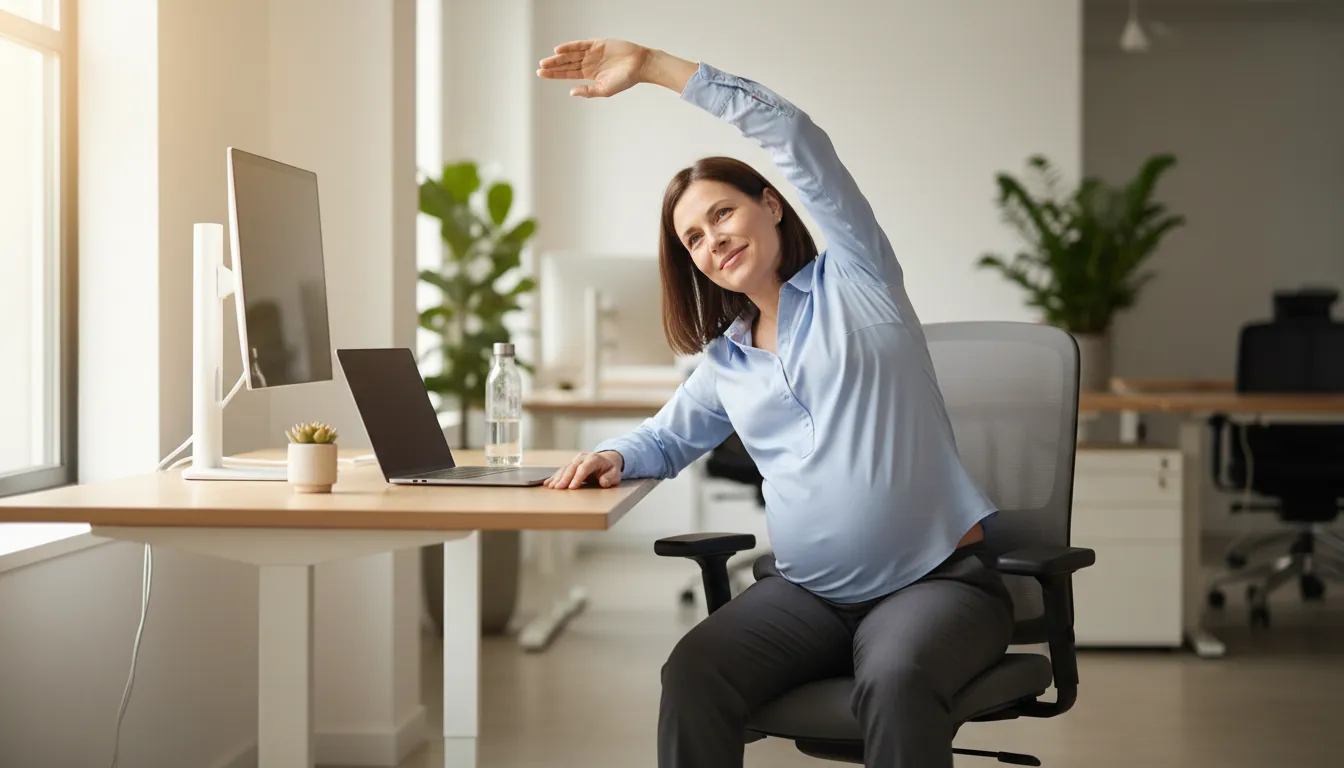
For the side stretch, reach your right arm long overhead and place your left hand on the chair armrest or your belly. Breathe in, and on the exhale bend gently to the left. Hold for 30 seconds, then repeat on the other side. This eases tightness in the sides of your body and stretches the hip muscles.
Movement Breaks That Go Beyond the Chair
Standing up and moving away from your desk even for a minute can change how your whole body feels. The following movements use your chair or a wall for support, which helps you stay balanced as your center of gravity shifts during pregnancy. They are useful when you have a little more space or a private moment. Taking this short break can also ease stiffness that builds up from sitting in one position for too long.
- Stand in front of your chair with your feet hip-width apart. Slowly lower yourself until your bottom taps the chair seat, then return to standing. Repeat for 60 seconds at a pace that feels right for you that day.
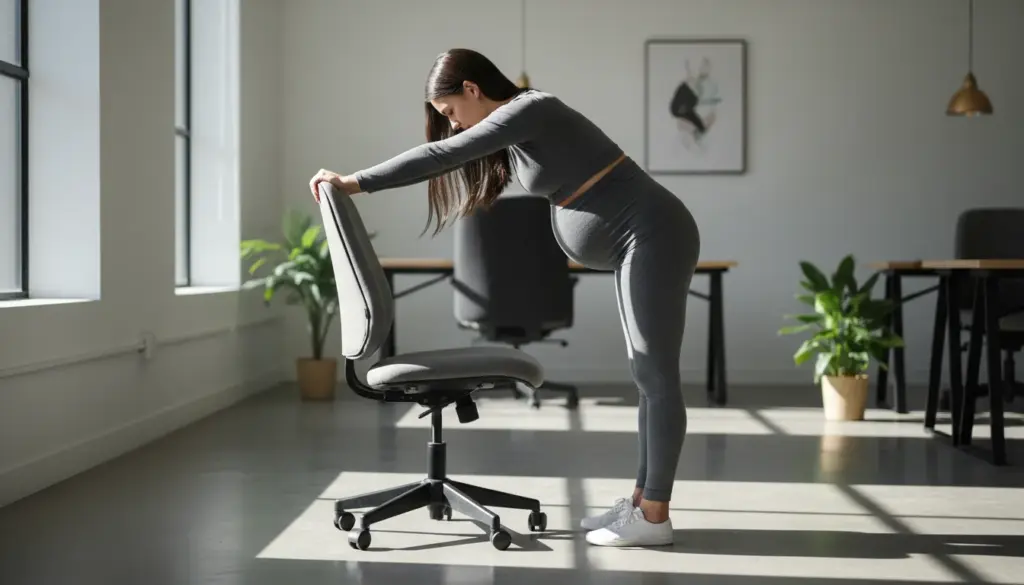
- Stand behind your chair with your hands gripping the back. Step back until your arms are fully extended, then breathe into the stretch, focusing on loosening the neck, shoulders and upper back.
- Place your hands on a wall at shoulder width. Step your feet back until your arms are straight but not locked. Slowly walk your hands up the wall three paces, breathe in, then walk them back down. Repeat.
- Stand with your feet hip-width apart and your toes, knees and hips facing forward. Tighten your tummy muscles and slowly lift onto your toes. Hold for a count of three, then lower slowly. Repeat 15 to 20 times.
- Sit on the edge of your chair with both feet flat. Lift your left leg and place your left foot on top of your right knee, keeping a 90-degree angle. Gently press the left knee as you breathe into the stretch. Hold for 30 seconds, then switch sides.
- While sitting, place your hands on your shoulders. Roll your shoulders forward 10 times, then roll them backwards 10 times to open the chest and upper back.
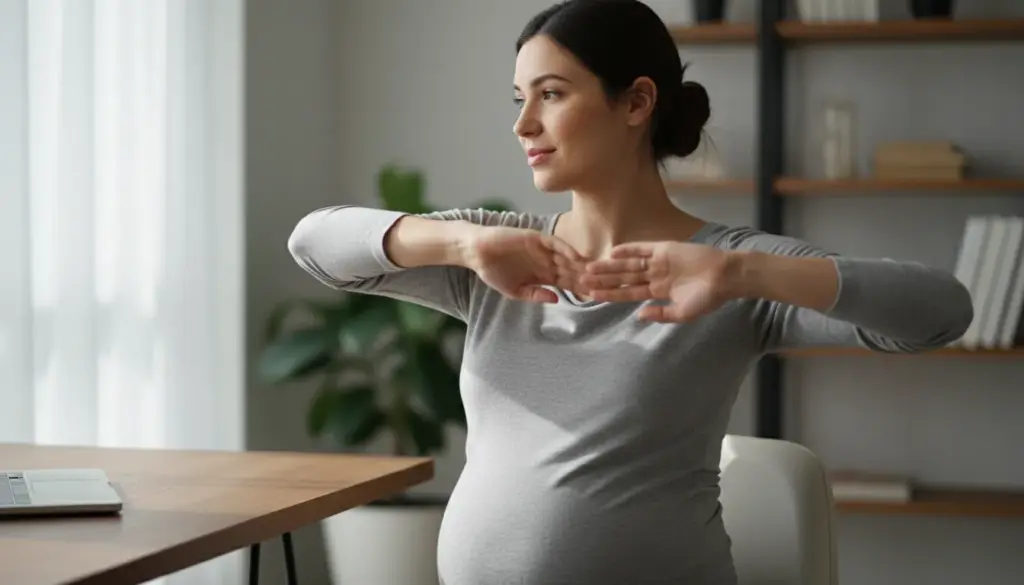
- Spread your arms to your sides, opening the chest, then bring them forward and clasp your hands together to stretch your back. Repeat 10 times.
These movements are not about endurance. They are about checking in with your body and releasing the stiffness that builds when you sit still for too long. Desk work often keeps you in one position, which can make your shoulders, neck, and lower back feel tight. Choosing two or three stretches that feel helpful on a given day is better than trying to do them all. This way you can stay comfortable without adding pressure to your schedule.
Building a Simple Daily Rhythm
Consistency matters more than intensity during pregnancy. A short stretch break at mid-morning and another in the afternoon can keep your back from seizing up. Try scheduling a five-minute movement break into your calendar once a day, then add a second one when it feels natural. Regular gentle movement helps ease back pain and reduce stiffness as your bump grows.
Pay attention to how your body responds. Some days you may want more movement, other days less. That is normal. The goal is to stay comfortable and connected to your changing body, not to push through fatigue. If you feel pain, dizziness or unusual shortness of breath, stop and speak to your healthcare provider.
Pregnancy-safe movement can fit into a working day without disruption. A few shoulder circles while reading email, a pelvic tilt during a call, a calf stretch while waiting for the kettle. These small acts add up. They help you finish the day with less tension and more ease, ready to rest and recover for the day ahead.