A new baby rearranges almost every corner of your day, and the idea of a dedicated workout can feel like a memory from another life. Yet movement in the early postnatal weeks does not have to mean leaving your baby, finding childcare, or waiting for a perfectly quiet hour. A folded towel on the living room floor and ten calm minutes can be enough to reconnect with your body. The key is to think less about intensity and more about gentle, consistent rebuilding.
Many women with uncomplicated pregnancies and deliveries can begin some resistance work within two to four weeks of giving birth. That timing is a guide, not a deadline. Your body is still healing, your sleep is probably fragmented, and your energy will rise and fall. The exercises that work best in this phase use your baby as a familiar, comforting weight and allow you to stop at any moment. You are not training for performance. You are re-establishing a sense of strength and rhythm.
Why baby-inclusive movement makes sense in the Gulf
Home workouts with a baby feel especially practical for parents in Qatar and the wider Gulf, where summer heat can make outdoor walks unpleasant for much of the day. Air-conditioned living spaces, a yoga mat, and a calm corner are often all you need. Your baby stays close, which reduces the mental load of arranging care and helps you respond quickly to fussing. The workout becomes part of your shared routine rather than a separate task.
Your baby does not need to be a specific age for most of these movements. What matters more is your own comfort and the support you can give your little one. Keep your movements slow, your breathing steady, and your attention on form. Holding your breath increases the risk of injury, so exhale on the effort and inhale on the return. If a move feels too difficult with your baby, do it alone first.
Building a short upper-body circuit
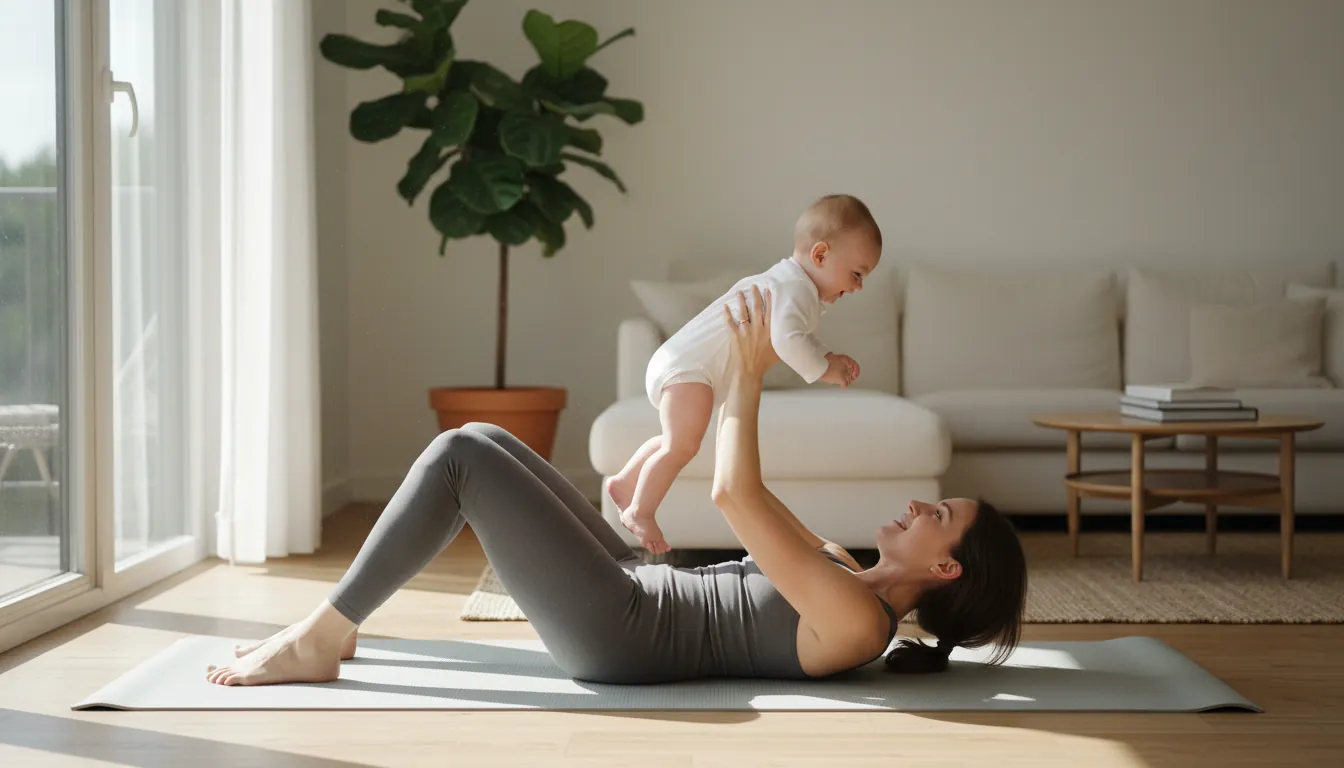
Upper-body strength becomes surprisingly relevant in the first months of parenthood. Babies love being lifted, and the hours of carrying, rocking, and settling add up quickly. A simple chest press lets you lie on your back with your knees bent and your baby held close to your chest. Straighten your arms without locking your elbows, lifting your baby above you so your eyes meet, then lower slowly. Inhale as you bring your baby down and exhale as you press up.

You can progress from ten repetitions to thirty and then fifty as your body allows. The movement should feel controlled, never rushed. Another option is the baby lift, where you begin with your baby on your stomach and push your arms up quickly but smoothly into the air. Lower your baby slowly until they are close to your body without touching. This builds shoulder and arm endurance in a way that mirrors the real lifting you do all day.
For a playful variation, try a push-up peek-a-boo. Set yourself in a push-up position with your baby underneath you, or start on your knees if that is more comfortable. Cover your eyes with one hand, lower your upper body with the other arm, then reveal your eyes and say peek-a-boo as you rise. It turns a strength move into a small game. Ten repetitions, alternating hands, are enough to feel the work without exhausting yourself.
Moves that engage the whole body
Baby weight squats are one of the most functional exercises you can do at home. Hold your baby in your arms, in your hands, or in a wrap, and stand with your chest lifted. Place your feet shoulder-width apart, push your hips back, and bend your knees as though you are about to sit on a chair. Keep your knees above your toes and avoid going too low, which can place excessive pressure on the joints. Rise slowly and repeat.
A nursery rhyme plank gives you a short core hold without any equipment. Lie your baby on their back just under you and come into a plank position on your forearms. You can stay on your toes for a harder version or drop to your knees for an easier one. Keep your body in a straight line and draw your belly button gently towards your spine. Hold while you sing your baby’s favourite nursery rhyme. The song gives you a natural timer and keeps your little one entertained.
For a longer hold, try the fly with me position. Start on your hands and knees with your baby on their back underneath you. Lift your left arm to shoulder height and your right leg behind you until it is parallel to the floor. Keep both hips facing down and your head in line with your body. Hold for about twenty-five seconds, stretching through your fingers and toes, then switch sides. This move asks for balance and control, so move slowly and reset if you feel yourself twisting.
Floor-based recovery moves for the early weeks
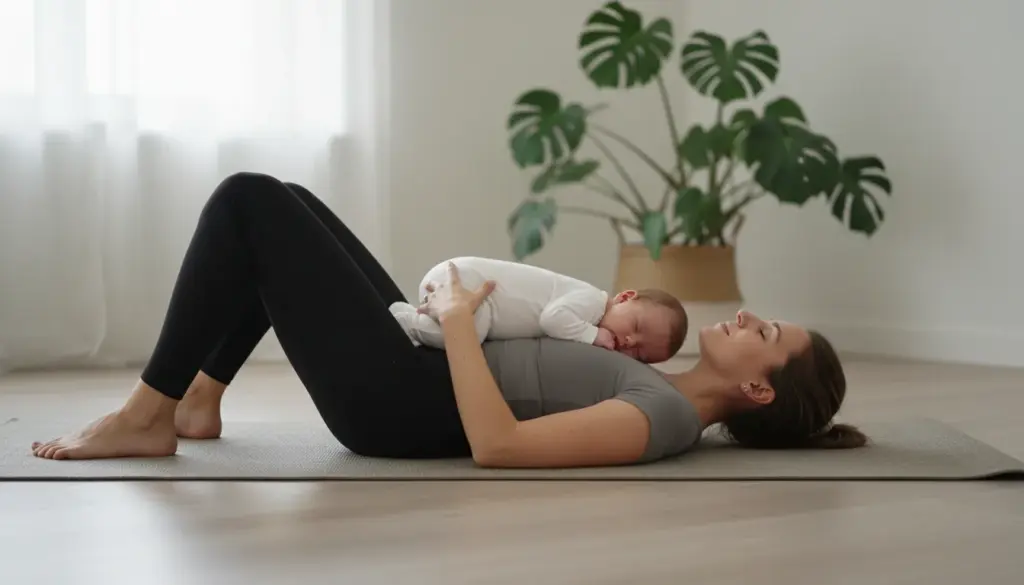
Lying on your back with your knees bent and slightly apart is a comfortable starting point for several gentle exercises. For curl ups, sit your baby on your chest and hold them securely with both hands. Draw your stomach in to engage your core, then curl upward a small distance. Ten repetitions can be enough. This is not a full sit-up and should feel like a gentle lift of the head and shoulders rather than a strain.
Glute lifts work the back of the body while keeping your baby close. Lie on your back with your feet flat and your knees bent, then sit your baby on your belly. Squeeze your buttocks and slowly lift your hips off the ground. Lower back down with control. You can also try pelvic lifts with your baby sitting against your thighs. Raise your mid-section, then come back down without letting your bottom touch the floor. These small pulses help rebuild stability around the hips and lower back.
Some women experience diastasis recti after birth, and abdominal exercises may need to be modified or delayed. If you notice a bulge or gap along the midline of your abdomen, speak with a women’s health physiotherapist before continuing. General guidance is useful, but your own body has the final say. Stop if you feel very tired, have pain, notice increased pelvic pressure, or experience urinary leakage, and contact your obstetrician or gynaecologist.
Sequencing your week without pressure
A realistic home routine does not need to follow a strict schedule. On a good day, you might complete a short circuit of four or five movements. On a difficult day, one set of squats or a short walk with the pram is still meaningful. The following list offers a simple way to structure a session when you have ten to fifteen minutes. Choose movements that feel comfortable and stop before fatigue turns into strain.
- Start with a gentle warm-up such as walking around the room or rocking your baby while standing for a couple of minutes.
- Do a chest press or baby lift for ten to fifteen repetitions to wake up the arms and shoulders.
- Move into baby weight squats for a comfortable number of repetitions, keeping your chest lifted and your knees tracking over your toes.
- Add a nursery rhyme plank or fly with me hold for twenty to thirty seconds to engage the core and hips.
- Finish on the floor with glute lifts or pelvic lifts for ten controlled repetitions.
- End with slow breathing and a gentle stretch of the neck, shoulders, and lower back while your baby rests on your chest.
- Repeat the circuit one to three times depending on your energy, but never push through pain or pressure.
Cardio and high-intensity interval training are not recommended until at least twelve weeks after delivery. That does not mean you should stay still. Walking with your baby outside in the cooler hours, or indoors in a shaded space, is one of the best ways to ease back into movement. The fresh air benefits both of you, and the rhythm of walking can settle a fussy baby. Build up gradually and let your energy guide the pace.
Creating a calm, repeatable home practice
The most effective postnatal workout is the one you can actually do. Keep a yoga mat or folded towel in a corner where you spend time with your baby, so the setup takes seconds. Wear comfortable clothing that allows you to move and to feed easily if needed. A small water bottle within reach is enough. You do not need special equipment, an app, or a perfectly tidy room. You need a few minutes and a little floor space.
Your baby may not cooperate with a full circuit, and that is normal. Some days they will doze through the movements. Other days they will cry, need feeding, or demand to be held upright. You can adapt by doing one exercise at a time and pausing between sets. The goal is not to finish a fixed routine but to stay connected to your body in a way that feels sustainable. Movement can be interrupted and still count.
Over time, these small sessions build a foundation for more demanding exercise. The strength you regain in your arms, back, hips, and core supports the daily work of caring for a baby. More importantly, it gives you a quiet ritual that belongs to both of you. You are not waiting for your old routine to return. You are creating a new one that fits the life you have now, one gentle repetition at a time.